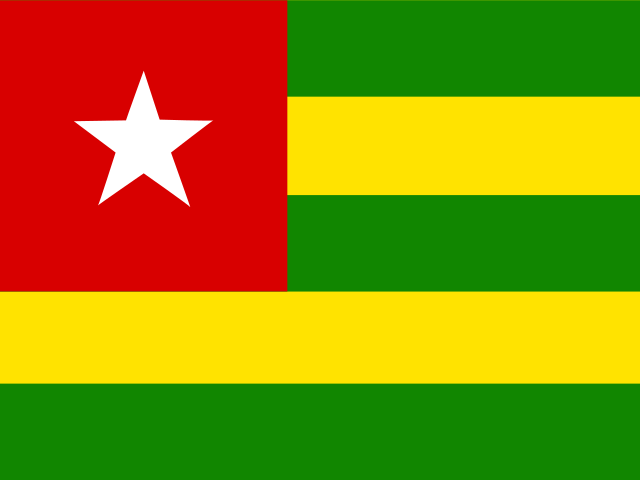
 Togo
Togo
Comprehensive education database information
Education System in Togo
Overview of Togo
The Togolese Republic, situated in West Africa, is bordered by Benin, Burkina Faso, Ghana, and the Gulf of Guinea. With a population of approximately 5.9 million, Togo has a literacy rate of 60.9%. The official language is French, which is also the primary medium of instruction in schools. Additionally, various African tribal languages are widely spoken, reflecting the country's rich cultural diversity, which includes 45 ethnic groups, with the Ewe, Kabyé, and Uaci being the most prominent.
Togo's historical context includes significant changes, especially during the colonial period. Initially dominated by various tribes, the area saw the arrival of the Portuguese in the late 15th century. By the late 19th century, it became a German protectorate and later a colony until World War I, after which it was divided into regions controlled by France and England. Togo gained independence in 1960 and has since developed its education system under the Ministry of Primary, Secondary, and Vocational Education.
Introduction to the Education System
Togo's education system is multi-faceted, encompassing various levels from primary to tertiary education. While strides have been made towards increasing accessibility, challenges persist, particularly in rural regions where educational resources are limited. The system is designed to provide foundational knowledge and vocational skills, reflecting the needs of both the local and national economies.
Primary Education
Overview
- Duration: Primary education in Togo lasts for 6 years.
- Cost: Education at this level is intended to be free and is officially compulsory for children aged 5 to 15.
- Ownership: The majority of primary schools are state-owned, although there are also Christian and Islamic institutions contributing to the educational landscape.
Challenges
Despite the framework for compulsory education, approximately 10% of children still lack access to basic education, especially in rural areas where educational resources are scarce and parents have historically had to pay teachers directly.
Secondary Education
Structure
- Duration: Secondary education encompasses an additional 6 years, divided into lower and upper secondary levels.
- Facilities: Educational resources can be limited in rural areas, while the capital city, Lomé, offers better facilities, including a range of private schools.
Curriculum
The curriculum at the secondary level is heavily influenced by the educational system of France, owing to the historical ties between the two nations. After completing lower secondary school, students are directed towards either vocational/technical pathways or general academic tracks.
Vocational Education
Providers and Structure
Vocational education in Togo is predominantly offered by religious organizations and supported by foreign donors. Many individuals gain essential skills through on-the-job training, which allows them to acquire practical experience while working.
Employment Skills
The vocational programs aim to equip students with specific skills necessary for the job market, although the informal acquisition of skills through employment remains a common practice.
Tertiary Education
Overview
- Location: Most tertiary education institutions are concentrated in Lomé.
- Institution Types: These include colleges specializing in administration, architecture, and urban planning.
University of Lomé
Established in 1970, initially as the University of Benin, the Université de Lomé focuses on training in various fields, including civil, electrical, and mechanical engineering.
Accessibility
Access to tertiary education tends to favor the wealthy and influential individuals, leaving many in rural areas with limited opportunities for higher education.
Teacher Education
Training for Educators
-
Primary School Teachers: Training for primary educators occurs over a one-year program at the École Normale d'Instituteurs (ENI), culminating in the Certificat de Fin d'Études Normales des Instituteurs (CFEN-ENI). Admission requires a baccalauréat.
-
Lower Secondary School Teachers: These educators are trained at the École Normale Supérieure at the University of Lomé, with a 3-year program post-Baccalauréat or a 1-year program following a DEUG.
-
Upper Secondary School Teachers: To teach at this level, one must possess a maîtrise.
Conclusion
The education system in Togo, while structured and comprehensive, faces significant challenges related to access and quality, particularly in rural regions. Efforts to enhance educational opportunities continue, with a focus on improving infrastructure and resources to ensure that all Togolese children receive the education they deserve.