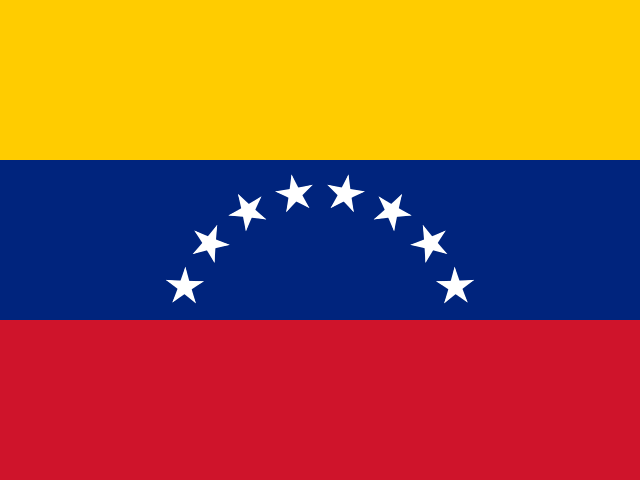
 Venezuela
Comprehensive education database information
Education System in Venezuela
Venezuela, known officially as the República Bolivariana de Venezuela, is a federal republic situated on the northern coast of South America. Bordered by the Caribbean Sea to the north, Colombia to the west, Brazil to the south, and Guyana to the east, it is home to approximately 25 million residents. The capital city, Caracas, along with other populous cities such as Maracaibo, Valencia, and Maracay, forms a vibrant urban landscape. Spanish is the official language, and the majority of the population adheres to Roman Catholicism, with a small percentage exploring other faiths. Historically, Venezuela has a rich cultural lineage, influenced by its indigenous peoples, Spanish colonization, and the revolutionary ideas of figures like Simón Bolívar, who played a pivotal role in the country's quest for independence in the early 19th century.
The Venezuelan education system is characterized by its structure and centralized approach, reflecting historical influences that prioritize accessibility and inclusivity. Education is seen as a fundamental right, and efforts have been made to provide a comprehensive educational experience from early childhood through higher education.
Primary Education
- Compulsory Duration: Education is mandatory for the first 9 years.
- School Year: The academic calendar typically runs from September to June/July.
- Literacy Rate: Venezuela boasts a literacy rate of approximately 95%.
- Enrollment: Over 92% of children are enrolled in primary education.
- Preschool Education: Many children attend preschool prior to beginning the 6 grades of primary education, usually until around the age of 11.
- Curriculum: While there is a standardized approach, academic standardization is limited primarily to the mathematics curriculum.
Middle Education
- Transition: After completing primary education, students receive a basic education certificate before advancing to middle school.
- Duration: Middle education encompasses an additional 3 grades.
- Specialization: At approximately ages 14-15, students in 9th grade must select between two educational tracks:
- Humanities
- Sciences
- Diversified Education Policy: This specialization is part of a 2-year diversified education policy aimed at tailoring education to student interests.
Secondary Education
- Structure: Since 2010, the Venezuelan education system has adopted a 6+5 structure, consisting of 5 years of secondary education.
- Certification: Upon completion, students are awarded one of the following titles:
- Bachiller en Ciencias (Bachelor in Sciences)
- Bachiller en Humanidades (Bachelor in Humanities)
- Professional Education: Certain institutions also provide vocational training, enabling students to earn the title of Técnico en Ciencias (Science Technician).
Vocational Education
- Industry Demand: The evolving industrial landscape has necessitated a reassessment of the national educational strategy.
- Technical Schools: An increasing number of youth are opting for professional education through various technical schools.
- Opportunities: These institutions offer a variety of self-improvement options, including:
- Short courses
- Full trade qualifications
Tertiary Education
- Institutions: Venezuela is home to nearly 100 higher education institutions, with around 1 million students enrolled in programs at no cost to them.
- Technical Institutes: Students attending technical institutes typically complete their training in 3 years, earning the title of licenciate technician.
- University Duration: Most university programs require 5 years of study for graduation.
- Advanced Studies: Graduates have the option to pursue master's and doctorate degrees afterwards.
- Prominent Institution: The Central University of Venezuela, established in 1721, stands as the largest and one of the oldest universities in the western hemisphere, with its main campus designated as a World Heritage Site in 2000.
In conclusion, the education system in Venezuela is designed to provide equitable access to education across all levels, from early childhood through tertiary education. It reflects the country's historical roots and ongoing commitment to fostering an informed and skilled populace in a rapidly changing socio-economic landscape.