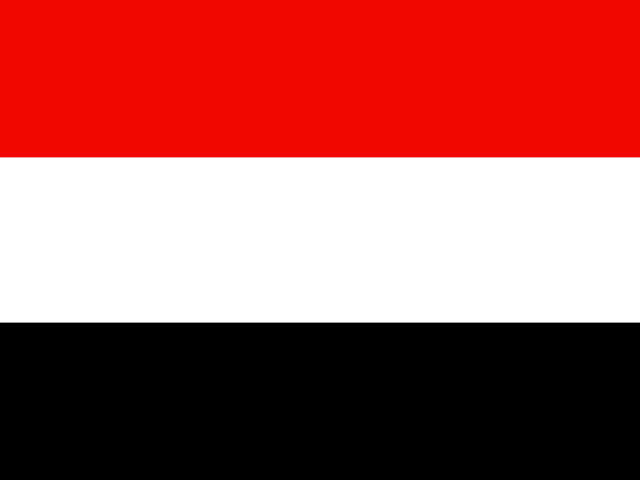
 Yemen
Yemen
Comprehensive education database information
Education System in Yemen
Yemen, officially known as the Republic of Yemen, is situated in the Middle East, bordered by Saudi Arabia to the north, Oman to the east, and flanked by the Gulf of Aden and the Arabian and Red Seas. The country has a population of approximately 23 million people, with a literacy rate hovering around 50.2%. The predominant language spoken is Arabic, which also serves as the medium of instruction in educational settings. Yemen has a rich history, being home to some of the earliest civilizations in the world. Throughout its history, Yemen has experienced various political changes, including periods of Ottoman and British control, before unifying as the Republic of Yemen in 1990.
The educational landscape in Yemen is managed by both the Ministry of Education and the Ministry of Higher Education and Scientific Research. Despite being a governmental priority, the education system faces significant challenges, particularly in ensuring equitable access for all segments of the population and promoting gender equality.
Overview of the Education System
Yemen's education system is structured into several key levels: primary, secondary, vocational, and tertiary education. Education is nominally free and compulsory for children between the ages of 6 and 15, although this requirement is not consistently enforced.
Primary Education
- The basic education program spans 9 years, beginning at age 6.
- While this education is theoretically compulsory, many children, especially girls, encounter obstacles that prevent full participation.
- Upon completing primary education, students receive the intermediate school certificate.
Secondary Education
- Secondary education constitutes the final three years of the 12-year educational cycle.
- Students follow a common curriculum in the first year of secondary school (grade 10).
- In grade 11, they select either a literary or a scientific track based on their interests and career aspirations.
- At the end of grade 12, students undertake the general secondary education certificate examination.
Vocational Education
- In addition to traditional academic pathways, students can pursue vocational training through various options, including:
- Technical secondary schools
- Vocational training centers
- Health manpower training institutes
- Agricultural secondary schools
- This vocational education system aims to equip students with practical skills that align with the labor market's demand for skilled professionals.
Tertiary Education
- Yemen's journey towards Western-style tertiary education began in the 1970s with the establishment of Sana'a University.
- There are currently 9 state-funded universities alongside several private institutions offering a range of programs.
- Noteworthy institutions include:
- Yemen University of Science and Technology, founded in 1994, which comprises four faculties:
- Medical Sciences
- Science and Engineering
- Sciences and Humanities
- An International College focused on Business, Information Technology, Arts, and Design
- Hadhramout University of Science and Technology also plays a vital role in advancing higher education in Yemen.
- Yemen University of Science and Technology, founded in 1994, which comprises four faculties:
Teacher Training
- Teachers for basic education are trained at 14 dedicated teacher training institutes, where they complete a 2-year program leading to a Teacher's Certificate.
- Those aspiring to teach at the upper secondary level must earn a Bachelor of Arts in Education.
Conclusion
The education system in Yemen is a complex structure that aims to provide opportunities for learning and development. While it has made strides in increasing access to education, particularly at the primary and secondary levels, challenges remain in achieving full enrollment and equitable access, particularly for marginalized groups. Continued efforts are necessary to strengthen the educational framework and ensure that all children in Yemen have the opportunity to receive quality education.