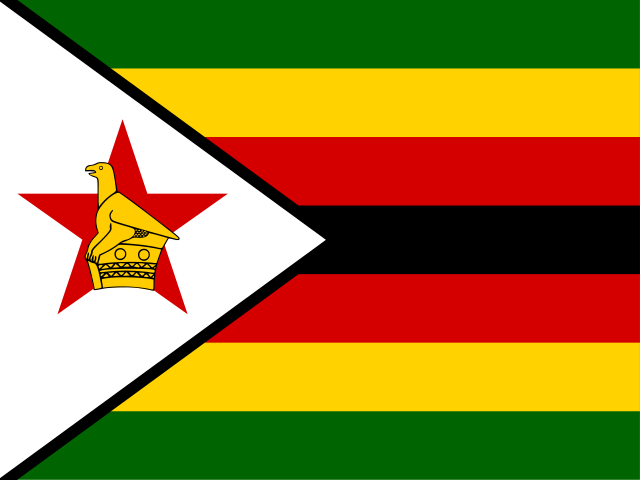
 Zimbabwe
Comprehensive education database information
Education System in Zimbabwe
Zimbabwe, a landlocked nation situated in southern Africa, is bordered by Botswana, Mozambique, South Africa, and Zambia. With a population of approximately 12.3 million, the country recognizes English as its official language, although a significant portion of the population speaks indigenous languages such as Shona and Ndebele. Notably, Zimbabwe boasts a literacy rate exceeding 90%, positioning it among the most literate nations on the African continent. The country's rich history includes periods of significant cultural and economic activity, particularly during the era of the Mutapa Empire and later under British colonial influence. Zimbabwe gained independence on April 18, 1980, transitioning from the colonial name of Rhodesia to its current title.
Overview of the Education System
The education framework in Zimbabwe is structured into a 13-year cycle, encompassing both primary and secondary education. The system is designed to provide foundational knowledge and skills to students, preparing them for further education or vocational training.
Primary Education
Primary education in Zimbabwe serves as the initial stage of formal schooling.
Key Features
- Duration: Typically commences at Grade 1 when children are around 6 years old.
- Medium of Instruction:
- In urban settings, English is the primary language of instruction.
- In rural regions, students are taught in either Shona or Ndebele until they reach Grade 3, after which the medium transitions to English.
National Examination
At the conclusion of Grade 7, students are required to take a national examination that assesses their understanding in several core subjects, including:
- English
- Mathematics
- One indigenous language
- Content (a blend of social and natural sciences)
Secondary Education
Zimbabwean secondary education is divided into two distinct phases, following the Cambridge 2-tier model.
O-Level Education
- Duration: This phase lasts for 4 years.
- Requirements: To complete O-Level, students must pass a minimum of 5 subjects, which typically include:
- English
- History
- Mathematics
- Science
- A technical or vocational subject
A-Level Education
- Duration: Following O-Level, students undertake an additional 2 years of study.
- Requirements: To qualify for A-Level, students must achieve at least 2 passes in their subjects.
Vocational Education
Vocational education in Zimbabwe focuses on providing practical skills necessary for the workforce.
Key Aspects
- Oversight: The Ministry of Education and Technology regulates vocational training programs.
- Training Centers: These programs are available at various state-run and private vocational training centers, primarily located in major urban areas.
- Polytechnic Colleges: These institutions specialize in advanced skills training, catering to the needs of various industries.
Tertiary Education
Tertiary education in Zimbabwe encompasses a range of institutions that offer higher learning opportunities.
Institutions Overview
Zimbabwe is home to 7 universities, which provide a variety of diploma and degree programs. These include:
- State-funded universities
- Religiously affiliated institutions
- A women’s university
- A distance learning open university
Notable Institution
The University of Zimbabwe, established in 1952 through a partnership with the University of London, is the oldest university in the nation. It features:
- Ten faculties
- Several specialized research centers and institutes
- The institution has faced challenges, including a funding crisis and student protests in 2008, yet continues to play a vital role in Zimbabwe's higher education landscape.
In conclusion, Zimbabwe's education system is comprehensive, catering to a diverse population and providing multiple pathways for academic and vocational advancement. Despite facing challenges, the commitment to education remains a cornerstone of national development.